
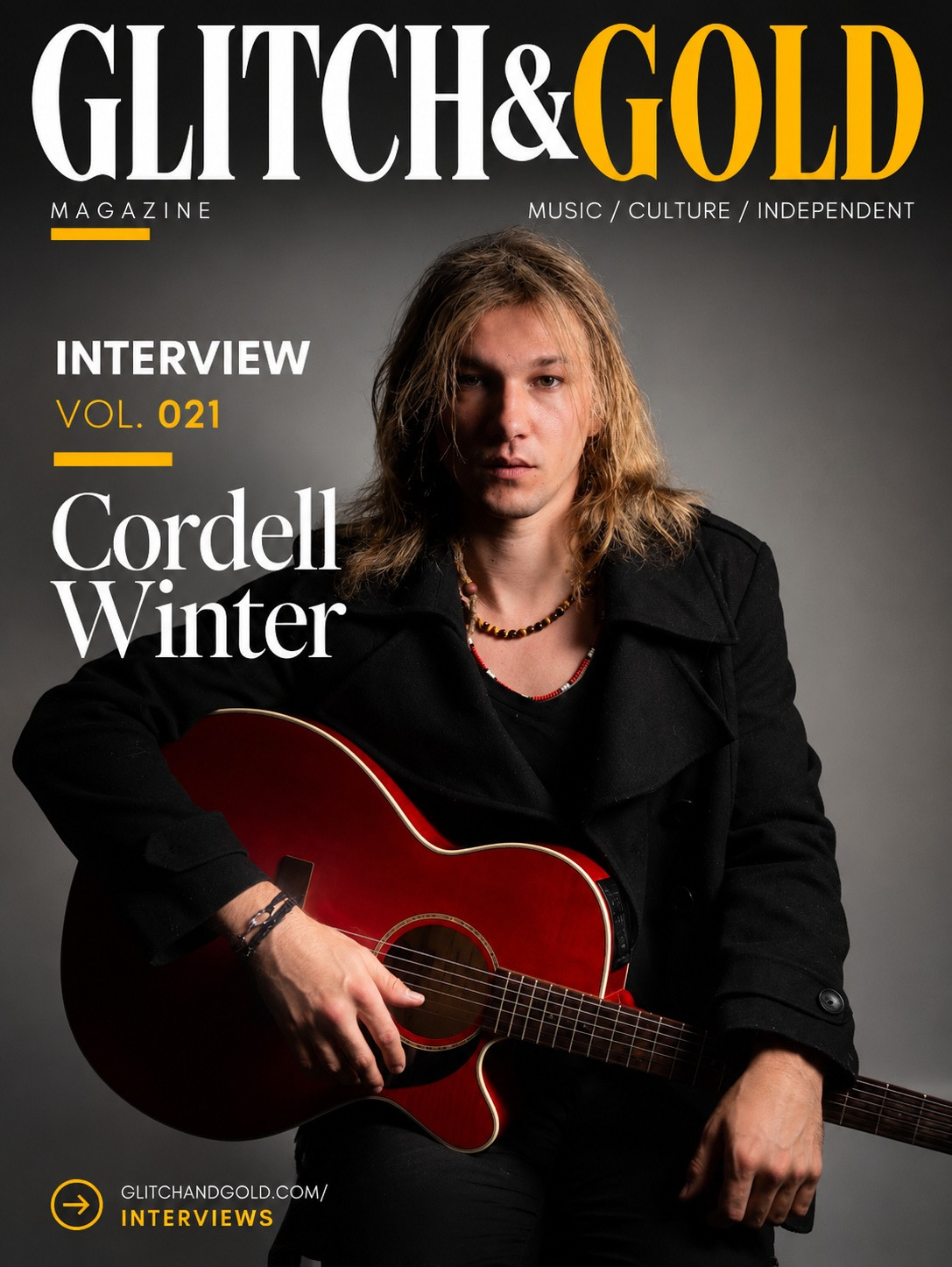
Photo Credit - Matt Workman / Videographer
For Cordell Winter, music has never been just about writing songs. It's about searching for meaning, questioning the world around him and finding something worth living for.
With Leave This World Alive, the singer-songwriter explores faith, heartbreak, ambition and the often painful pursuit of a lifelong dream. Working alongside Lincoln Parish, Winter has shaped a deeply personal collection of songs that reflects both the struggles and revelations of his journey.
In this conversation with Glitch&Gold, he opens up about broken promises in the music industry, life on the road, spiritual awakening and his refusal to compromise his identity as an artist. Above all, he reflects on what it really means to be alive.
01 — WHAT IT MEANS TO BE ALIVE
Leave This World Alive is framed around survival, faith, love and transcendence, but the title itself almost sounds like a contradiction. What does “leave this world alive” actually mean to you?
For me, the title is a challenge to the listener, and perhaps even more so, a question to ask oneself: Are you leaving this world with a mind that is alive in truth and consciousness? Or are you simply existing, bound by the systematic chains of the world you were born into?
I think it’s ultimately a statement about what we’re choosing to live for. Are we living for something greater than ourselves, beyond the ego and our own selfish desires, or have we become prisoners of them?
Of course, no one leaves this world alive in the physical sense, and I think that’s where the contradiction becomes important. For those who believe the human soul is eternal that’s the key. To me, it’s about awakening to that truth and recognizing that being alive is something far greater than simply being here to exist.
02 — AFTER THE CHAOS
Chaos In Light came out of a period you’ve described as fractured, while this new era feels much more focused on purpose and meaning. What changed in your writing between those two records?
I wouldn’t necessarily describe Chaos In Light as fractured. I’d describe it as fervent and teeming with life, with no restraints on the possibilities of the human experience. It was about one’s maddest dreams and the realities they could become if only one were fearless enough to pursue them, despite the constructs we’re bound by in the world we live in.
The fracture had less to do with the music itself and more to do with the challenge of pursuing artistic expression in an industry often governed by businessmen and, unfortunately, con artists. There are a lot of money men making decisions about what gets seen, and what gets seen isn’t necessarily the truth.
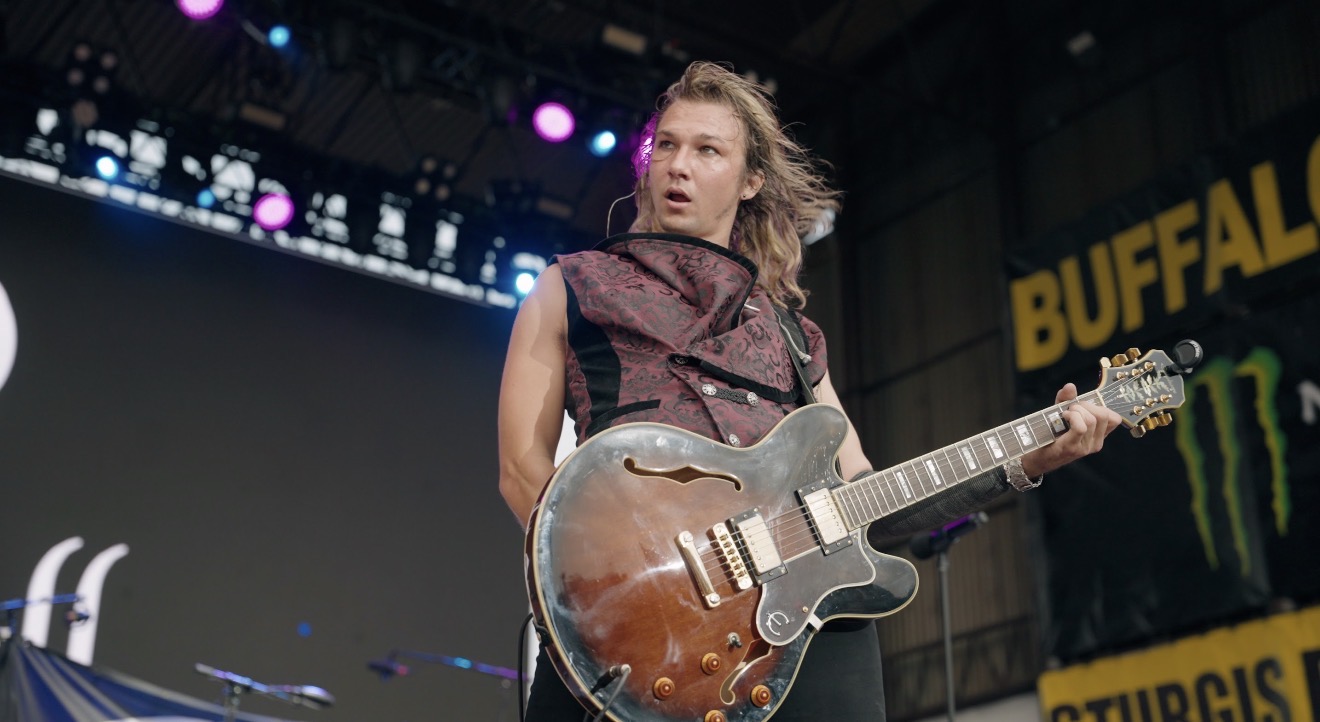
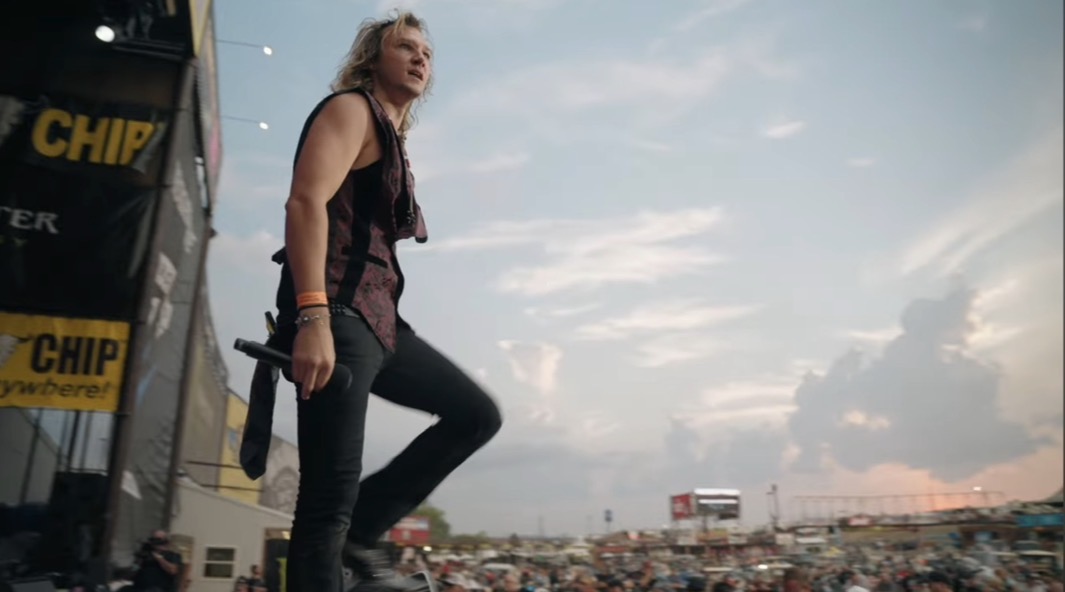
I’d been given a lot of career promises that never materialized. Eventually, I decided to take my own life into my hands rather than leave my future in the hands of others. That decision led me to opportunities I had spent years working towards, from performing alongside Yungblud and Billy Corgan to playing the Sturgis Buffalo Chip, and now preparing for a tour across Europe and the UK. Sometimes you can’t take no for an answer. Sometimes you have to fulfill those promises on your own accord. Nobody will work harder for you than yourself.
As for the writing, I think the difference between the two records comes down to the human experience.
Chaos In Light was a mysterious period of life, exploring all its subjects in full throttle and in their rawest forms. Everything was constantly peaking and beautiful in both Joy and Pain. It was an exploration of life without necessarily knowing where it would lead.
The album title itself means chaos with reason. There is a disordering of all the senses and the pushing of your senses to become a seer, there is chaos in finding the light in its most illuminate form. As long as your actions are intentional “Chaos In Light”
Leave This World Alive, on the other hand, is almost reminiscent of the story of Icarus. It’s the descent and ascent of a lifelong dream. There’s loss, devastation, heartbreak, betrayal, but also optimism. It’s about the experience of living for something your entire life, only to arrive at a point where you have to confront the possibility that you may never reach your deepest dream. And I think that’s something that resonates with so many other human beings. You can hear that particularly in a song like “Love Well.”
In brief, I think the album embodies an entire lifetime: the story of a child working towards a vision and a dream he can’t even put into words, something he feels was placed in his hands by something higher than himself. Then, somewhere along that journey, feeling abandoned by that same voice, left behind by everything and everyone he loved, and wondering if there would ever be a tomorrow.
It was almost the aftermath and answer to chaos in light being Leave This World Alive as the revelation.
But ultimately, I think the album radiates the same optimism that there is a tomorrow. That the dream never ends until you do.
It’s an inseparable story called life, in pursuit of poetry.

03 — FIFTY SONGS, SEVEN CHOSEN
Lincoln Parish has become central to this new body of work, yet very little has been said about how the two of you actually create together. What did he hear in your music that made you trust him with this record, and what has he pushed you toward that you might not have reached alone?
I believe Leave This World Alive is, in many ways, a testament to proving people wrong who doubted my abilities as a songwriter.
I reached out to Lincoln personally and sent him more than 50 songs I had written over the course of three months. We eventually sat down together and chose seven of them to develop for the record. He was incredibly enthusiastic about me as a songwriter and saw the potential for me to become a force in Alternative and Indie Rock.
What really stood out to me was how naturally everything came together. For the first time in my career, I experienced such an easy and fluent creative relationship with someone in the studio. Every idea was acknowledged, nothing felt forced, and we were able to build upon each other’s ideas in a really beautiful way.
Working with Lincoln was also a dream of mine. I’ve been a big fan of Cage the Elephant for years, and I think they brought a very distinct, modern language to rock music. I admired that, and getting the opportunity to work alongside someone who helped shape that sound I dreamed of but couldn’t always convey to past producers was something I genuinely cherished.
I think what Lincoln brought out of me was a greater confidence in trusting my instincts as a songwriter. He gave the songs room to become what they were meant to be, while challenging me to explore what they could become beyond my initial vision. It was a very collaborative experience, and I thoroughly enjoyed making this record with him.
04 — WHEN LESS SAYS MORE
You often describe poetry, philosophy and mysticism as sources you draw from, but songwriting forces those ideas into a very different form. How do you know when an idea should become a song rather than a poem, a piece of writing or something you leave unresolved?
My earlier album was very contemplative when it came to the lyrics. I wanted perfection. I wanted to feel that I had landed somewhere artistically that could stand the test of time. I was very particular about every word and what I was trying to communicate.
As time went on, I learned that I had to find some middle ground. I wanted to continue saying things that carried the same depth and truth, but in a way that could be understood more easily by the listener. Sometimes that’s actually more difficult for me.
If I had it entirely my way, every song would probably be an eleven-minute trip with poetry layered over it, exploring the deepest things I could possibly conjure up. Haha.
But in the world we live in today, I’ve learned to find a balance between remaining true to myself and communicating something that people can connect with universally, sometimes in just two and a half minutes.
That’s not to say I’m compromising artistically by any means. I actually enjoy finding ways to say something honest and universal without necessarily having to say everything. Sometimes less is more.
Ultimately, I want people to feel something, to think about something, or perhaps even walk away seeing the world a little differently.
05 — THE POET AS SEER
Songs like “Don’t Make A Sound” and “Love Is All I Got” place romantic love alongside ideas of salvation, God and mortality. Has that spiritual language always existed in your songwriting, or has it become more important as you’ve moved into this album era?
I think I’ve always approached my endeavors in art with the intention of reaching for something that either hasn’t been said before or, at its very core, holds an unbreakable truth.
I feel as though I’m wasting people’s time if I’m simply trying to write a song because I think it will sell, because it talks about being at a bar, getting drunk, or some other surface-level experience. I’d much rather reach for a transcendental moment between two people, or explore something that touches the human soul on a much deeper level. Personally, I’d have a hard time manufacturing that kind of visceral, bestial expression that you hear in so much modern pop music. It wouldn’t feel honest to me.
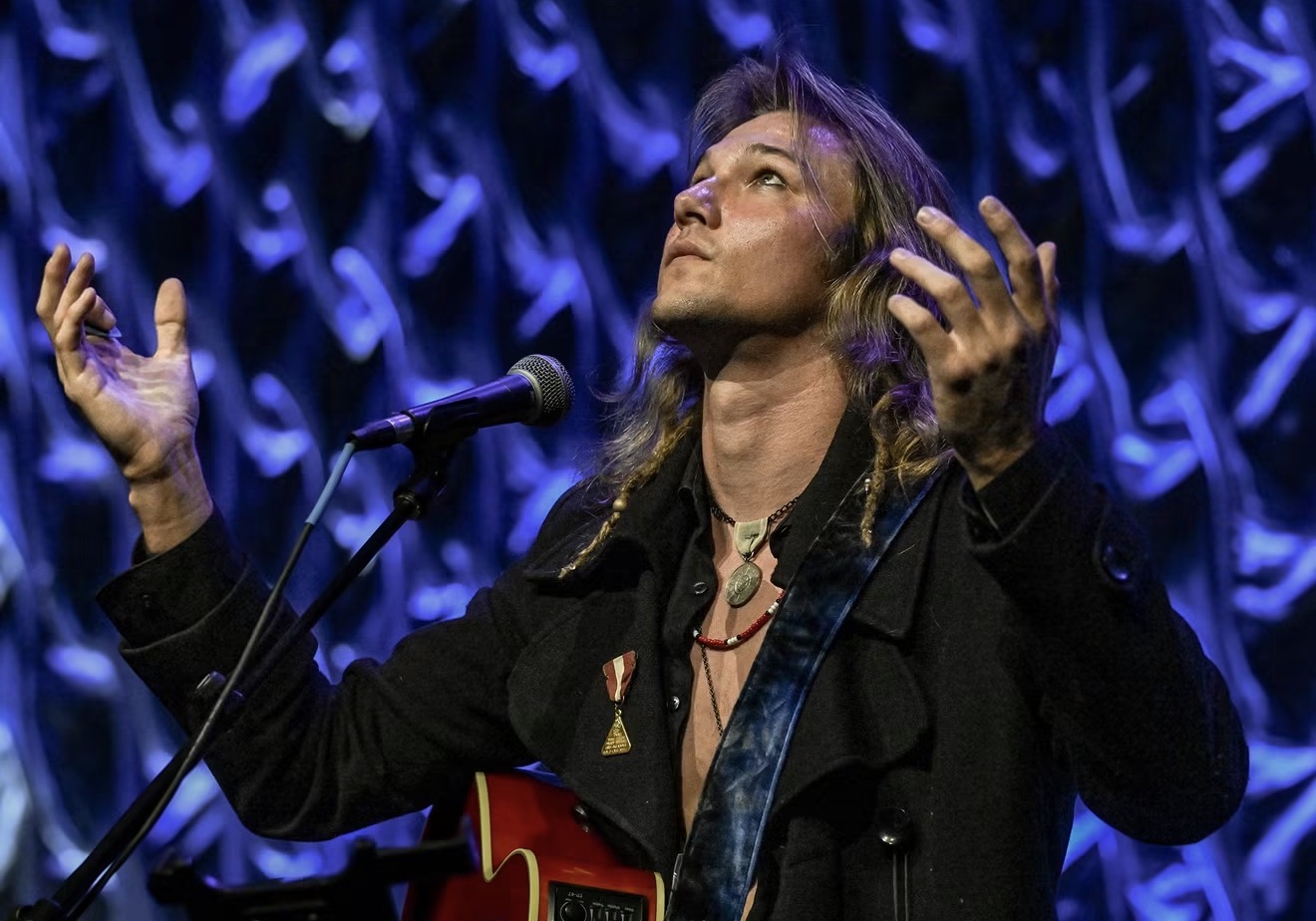
I’ve always believed the poet makes himself a seer through a long, vast, and painstaking derangement of all the senses.”
To me, that speaks to the idea that a poet must move beyond the limitations of his own ego and personal experience, becoming receptive to something greater than himself. Almost as though the artist becomes a conduit for visions, voices, and truths that extend beyond his own understanding.
I’ve always considered myself a poet before a musician, and I mean that both in theory and in lifestyle. It’s about seeking the highest, most unexplored levels of human existence and trying to uncover those truths through your art.
So I don’t think that spiritual language is necessarily something new to this album. I think it’s something that has always existed in my writing and life, perhaps becoming more apparent as I’ve grown and experienced more of life.
I believe that if I ever lost that as the foundation of my creative process, I’d have truly lost myself.
After all, what is art if it isn’t the limitations of the human soul being pushed?
06 — WHAT ARE YOU WILLING TO SUFFER FOR?
You’ve said that suffering is unavoidable and that the real question is deciding what is worth suffering for. Has making Leave This World Alive changed your answer to what is actually worth suffering for now?
I think I always knew what was worth suffering for. Like when I was 15 and got an Astro van and painted it all up on the outside… I knew then I wanted to live on the road, there was nothing that was going to stop me. There’s a line in “Love Is All I Got” where I wrote, “You suffer rich, you suffer poor, so what do you suffer for?” That came from a realization that suffering is inevitable, regardless of the circumstances you find yourself in. The question is what you’re willing to endure it for.
You can suffer working a nine-to-five job, fulfilling all the needs you’ve been conditioned to believe will make you happy. The television, Netflix, material possessions, and all the other distractions that become part of what society tells us a fulfilling life should look like.
Or you can choose a different kind of suffering. You can choose to live with less, to step outside those expectations and pursue something that might not offer you financial security or conventional comfort, but gives you something much harder to put a price on.
In my case, that meant living in a van and stripping away almost everything outside of the things I genuinely needed. It meant finding myself watching the sunrise, sitting in the silence of the Colorado mountains, or coming face to face with a raven in the middle of the desert. I began to realize that those moments had more glitter than gold, and ultimately, were priceless.
I think all of life involves suffering in one form or another. But I chose to suffer in pursuit of happiness and peace rather than suffer in pursuit of creating peace through material things.
I also believe we’ve been given everything we need in this life to learn and acquire the wisdom we’ll ever need. I always said “things that remain untouched by man and only created by God are the only things you ever will truly need. You can learn more sitting beside an ocean or staring at a tree than you will in a classroom or looking at your phone.
I think all the wisdom and love we could ever hope to understand has been here all along. Unfortunately, I feel people are losing touch with that more and more every day.
I’ve always admired the Beat Generation poets and writers, people like Jack Kerouac and Charles Bukowski, who explored that relationship between existence, freedom, suffering, and the human experience.
So I don’t think making Leave This World Alive necessarily changed what I believe is worth suffering for. If anything, it reaffirmed it. I’d rather suffer for a life that allows me to feel alive than spend my life making myself comfortable in one that doesn’t.
07 — STRIPPED BACK TO THE BEGINNING
“Anymore” was released acoustically in a version described as “stripped back to how it was written.” How much distance is there usually between the first version of a song you write and the finished recording people eventually hear?
A lot… haha… a ton goes into production and parts but the song alone was written by an acoustic guitar or a piano.
08 — A PLACE FOR THE OUTSIDERS
You’ve built much of your identity around anti-conformity and refusing to shape yourself around industry expectations. As larger stages, international touring and bigger opportunities arrive, does protecting that outsider instinct become harder?
Not really. I am who I am, and I’m the same person on and off the stage.
I suppose you could describe me as a poet striving to be a rock-and-roll revolutionary. An artist defined by intellectual rebellion, poetic expression, spiritual searching, and an almost uncompromising devotion to individuality.
If anything, I think it was harder in the beginning. There were times when I felt I had to be more reserved in meeting rooms and around certain industry people, almost as though I had to suppress parts of my personality to make myself more palatable to be signed. Ironically, after playing some bigger stages and sharing the stage with artists like Yungblud, I’ve found that people increasingly gravitate towards honesty. It’s become easier to show people exactly who I am and what I stand for.
I’ve never been afraid to be myself, whether I was at a Grateful Dead lot or in Nashville, Tennessee. I’ve always tried to invent myself as an individual rather than inherit an identity from whatever scene I happened to find myself in. I never felt the need to wear a cowboy hat or a tie-dyed shirt just to belong to a particular culture or click.
In fact, I think I’ve always wanted to create my own scene, to give people a place where they could belong when they felt they didn’t belong anywhere else.
And I think those are the people I’m speaking to at the end of the day. The outsiders, the misfits, the independent thinkers, and the people who have never quite found themselves represented by the world around them.
I don’t necessarily want to fit into an existing movement. I’d rather help create something that gives someone else the courage to be entirely themselves.
09 — A MOMENT YOU CAN NEVER RECREATE
Leave This World Alive has had a long and somewhat shifting path toward release. Without assuming what happened behind the scenes, how has that extended process affected your relationship with the album itself?
There are still two singles left to be released from Leave This World Alive, Stand By My Side and Love Well , but creatively, I’ve already started recording and writing for my third record and will be in the studio this winter.
I get incredibly excited about the creative process, but I also feel a tremendous responsibility to continually reach for my highest self. I’m always striving to discover something in myself that I haven’t quite reached before.
The craziest thing about music is that once you create a song, it becomes a part of your life forever. Those songs will always be there. They’ll exist long after the particular moment, circumstances, and person you were when you wrote them have passed.
I’m incredibly proud of this album and what it represents. I feel as though I reached a part of myself through making Leave This World Alive that I’ll never be able to reach in quite the same way again. And I think that’s part of the beauty of creating something. You capture a moment of your existence that can never truly be recreated.
Now I can only strive to reach that same depth, honesty, and level of expression in the next collection of songs that come into my life.
10 — POETRY AS PURPOSE
You once said, “Without music, I’m nameless and faceless.” After everything that has happened since Chaos In Light, do you still experience music as something you do, or has it become impossible for you to separate it from who you are?
There were many times throughout periods of destitution and difficult circumstances when I genuinely thought about giving it all up. But then you sit there and ask yourself, what on earth would I be without it? Besides a ghost, perhaps.
At least it feels that way when I’m backpacking in other countries.
My music and I are one and the same. I honestly can’t imagine a life without it.
Even when I’m older, I know I’ll always be a poet first. I’ve already been planning to write and publish my poetry books, and beyond that, I’ve contemplated writing the story of my life.
But who knows where life will take me beyond that? I’ve thought, toyed with the idea and planned about becoming a sailor and sailing across the ocean, or playing music in small villages for people who might appreciate hearing nothing more than a simple tune for those in need. I’ve thought about finding my way to some of the biggest waves in the world to surf.
I don’t believe there should ever be limitations on the experiences one pursues or the places life can take you, because all of those experiences ultimately find their way back into your writing and your music. I want to continue pushing the boundaries of the human spirit and discovering what it means to be alive at every stage of my existence.
Poetry is my purpose. And I think the greatest thing I can do with that purpose is give something of myself to others, perhaps helping the future move a few steps further in love