
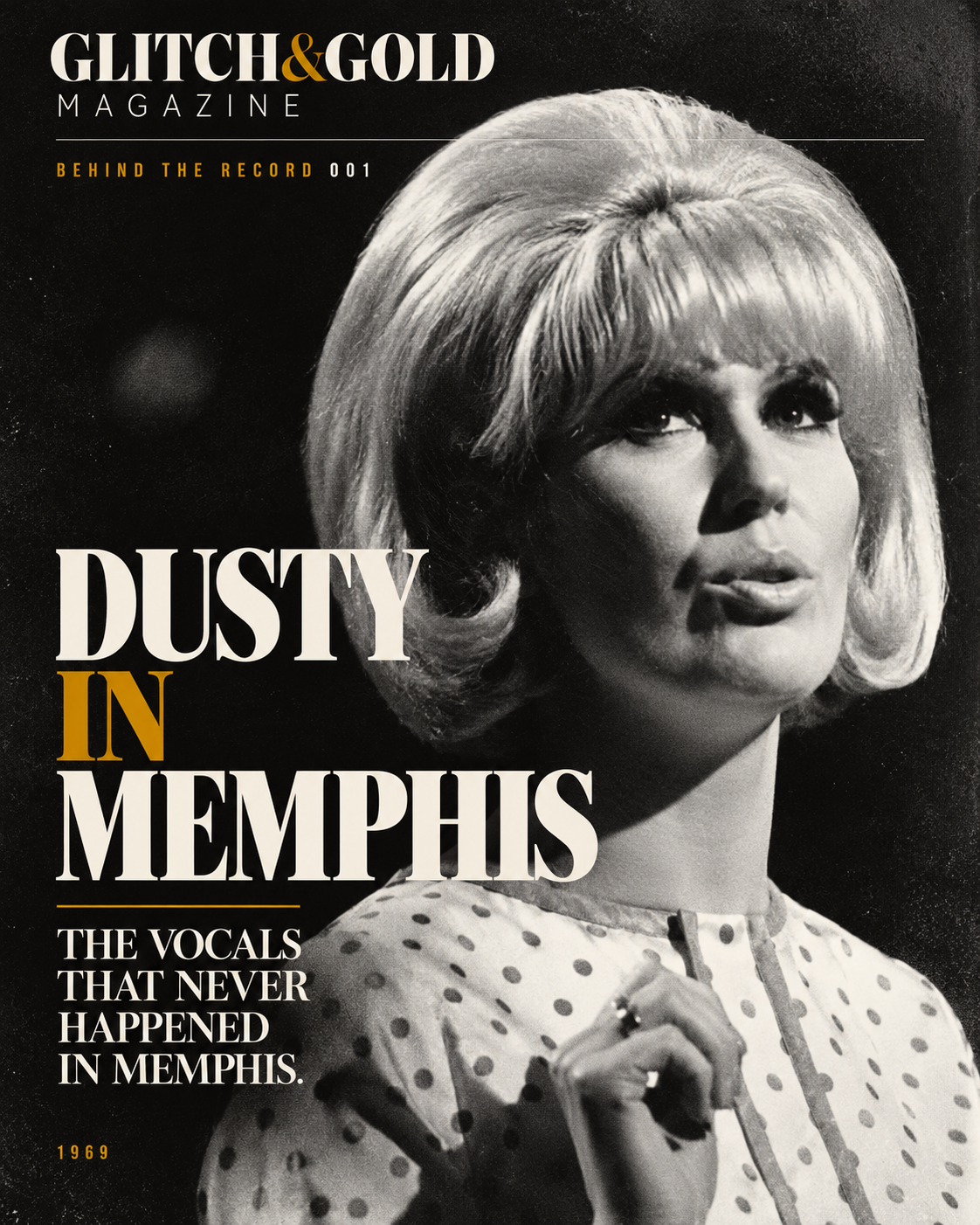
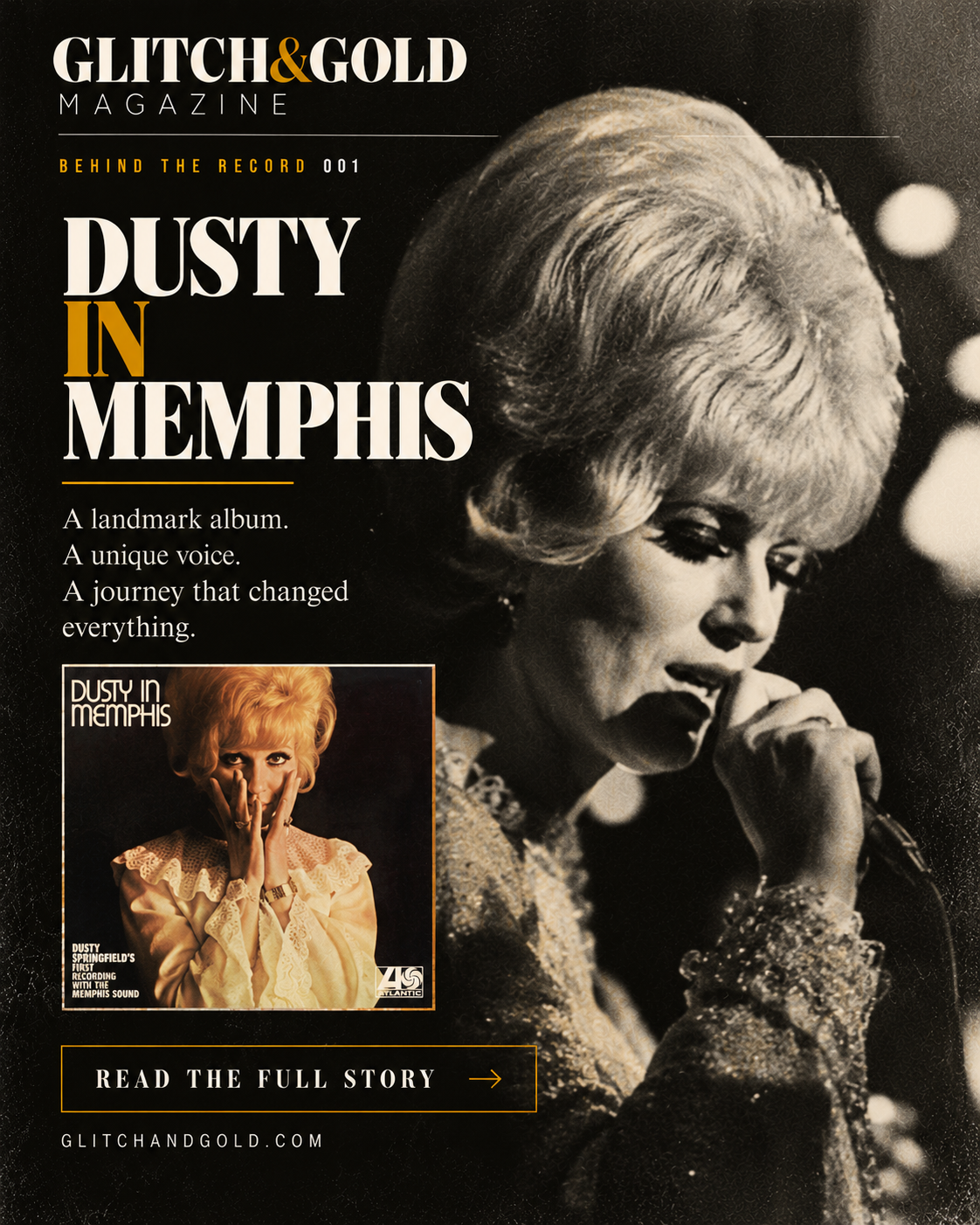
DUSTY IN MEMPHIS
The vocals that never happened in Memphis.
BEHIND THE RECORD 001 | GLITCH&GOLD MAGAZINE
In September 1968, Dusty Springfield travelled to Memphis to make a soul record.
She had the songs.
She had Jerry Wexler, one of the most important producers in American rhythm and blues.
She had a studio band that could make three chords sound like the most interesting thing anybody had ever thought of.
And she had that voice.
Good heavens, that voice.
There was just one problem.
Dusty couldn't quite bring herself to sing.
The musicians played. The arrangements took shape. The tape machines rolled. But the British singer who had crossed the Atlantic to work with these people found herself unable to deliver the lead vocals they needed.
Eventually, the recordings went to New York, where she completed her performances.
The finished album was called Dusty in Memphis.
Naturally.
It became one of the most admired records in her catalogue, a meeting of British pop sophistication and American Southern soul that still sounds remarkably intimate.
And its most important ingredient, the voice everybody had travelled there to record, was largely added somewhere else.
There is a rather wonderful contradiction in that.
But to understand how it happened, we need to go back to the beginning.
THE WOMAN WHO ALREADY KNEW SOUL
By 1968, Dusty Springfield was hardly an unknown singer hoping America might give her a chance.
Britain had known her for years.
There had been I Only Want to Be with You, You Don't Have to Say You Love Me, All I See Is You and a succession of records that established her as one of the country's most distinctive pop voices.
The extravagant hair. The eye makeup. The carefully constructed stage image.
And underneath it all, an extraordinary instinct for phrasing.
Springfield could make a small hesitation in a lyric sound like an entire conversation.
She had also been listening closely to American soul long before anybody suggested putting Memphis on an album sleeve.
Rhythm and blues, gospel, Motown and the music coming out of Atlantic Records were central to her musical education.
She admired the singers who could take a song apart emotionally without making the performance feel calculated.
Aretha Franklin was one of them.
And that admiration would eventually become rather inconvenient.
Signing with Atlantic offered Springfield the chance to work with the people responsible for records she loved. Jerry Wexler, in particular, understood how to connect a singer with songs, musicians and arrangements that might reveal something unexpected.
He was already an admirer of her voice.
This was an opportunity to move beyond the elaborate pop productions with which she had become associated.
Not to abandon pop.
And certainly not to pretend she had suddenly discovered soul.
She wanted to make a record closer to the American music that had informed her singing for years.
Wexler was prepared to help.
First, though, they needed some songs.
FIFTY SONGS AND A VERY PATIENT PRODUCER
Wexler later recalled that finding the material was no simple matter.
Springfield was an interpreter rather than a songwriter, so the album would depend heavily on selecting the right compositions.
He and his colleagues gathered possibilities from some of America's finest writers.
Gerry Goffin and Carole King.
Randy Newman.
Barry Mann and Cynthia Weil.
Burt Bacharach and Hal David.
The material was formidable.
Springfield, however, was difficult to satisfy.
Wexler remembered going through an enormous number of songs without reaching agreement. An initial session plan had to be abandoned.
Eventually, after another round of listening and selection, they settled on a collection that both singer and producer could believe in.
It is worth dwelling on this.
The songs weren't simply vehicles for a voice.
They were the foundation of the record.
There is an extraordinary range of emotional situations across Dusty in Memphis: romantic excitement, humiliation, loneliness, tenderness, self-deception and the small, rather embarrassing compromises people make when they want to be loved.
The writers understood these things.
So did Springfield.
Now they needed a band.
Wexler had originally considered recording at Muscle Shoals, another centre of Southern soul.
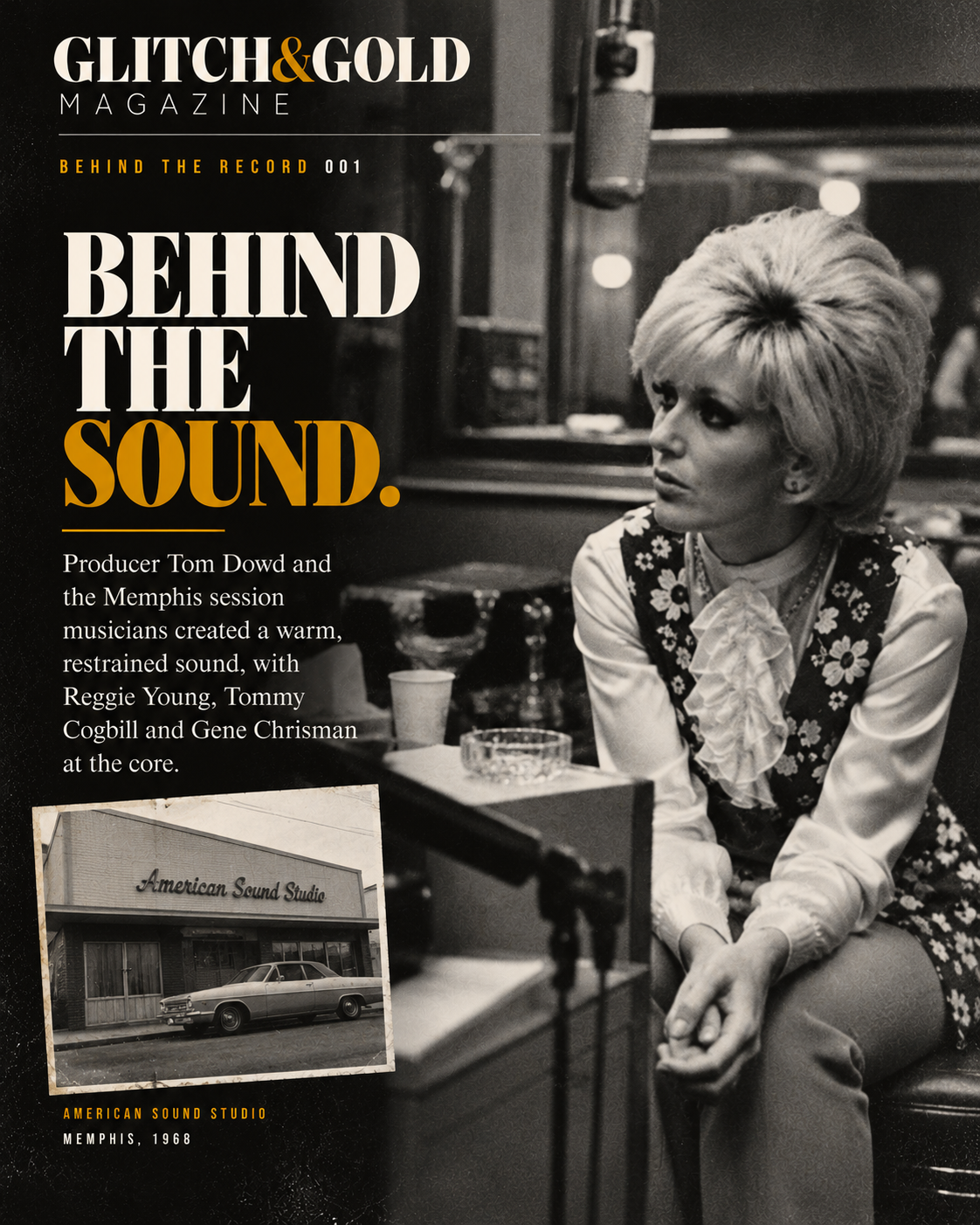
Scheduling difficulties eventually brought the project to American Sound Studio in Memphis.
A fortunate complication.
Because the musicians waiting there were something special.
A STUDIO THAT DIDN'T LOOK LIKE MUCH
American Sound Studio was established by producer and guitarist Chips Moman in 1964.
Its home was a relatively unremarkable building in North Memphis, at 827 Thomas Street.
Hardly the sort of place designed to impress visiting international pop stars.
But by the late 1960s, it was becoming one of the most productive recording rooms in America.
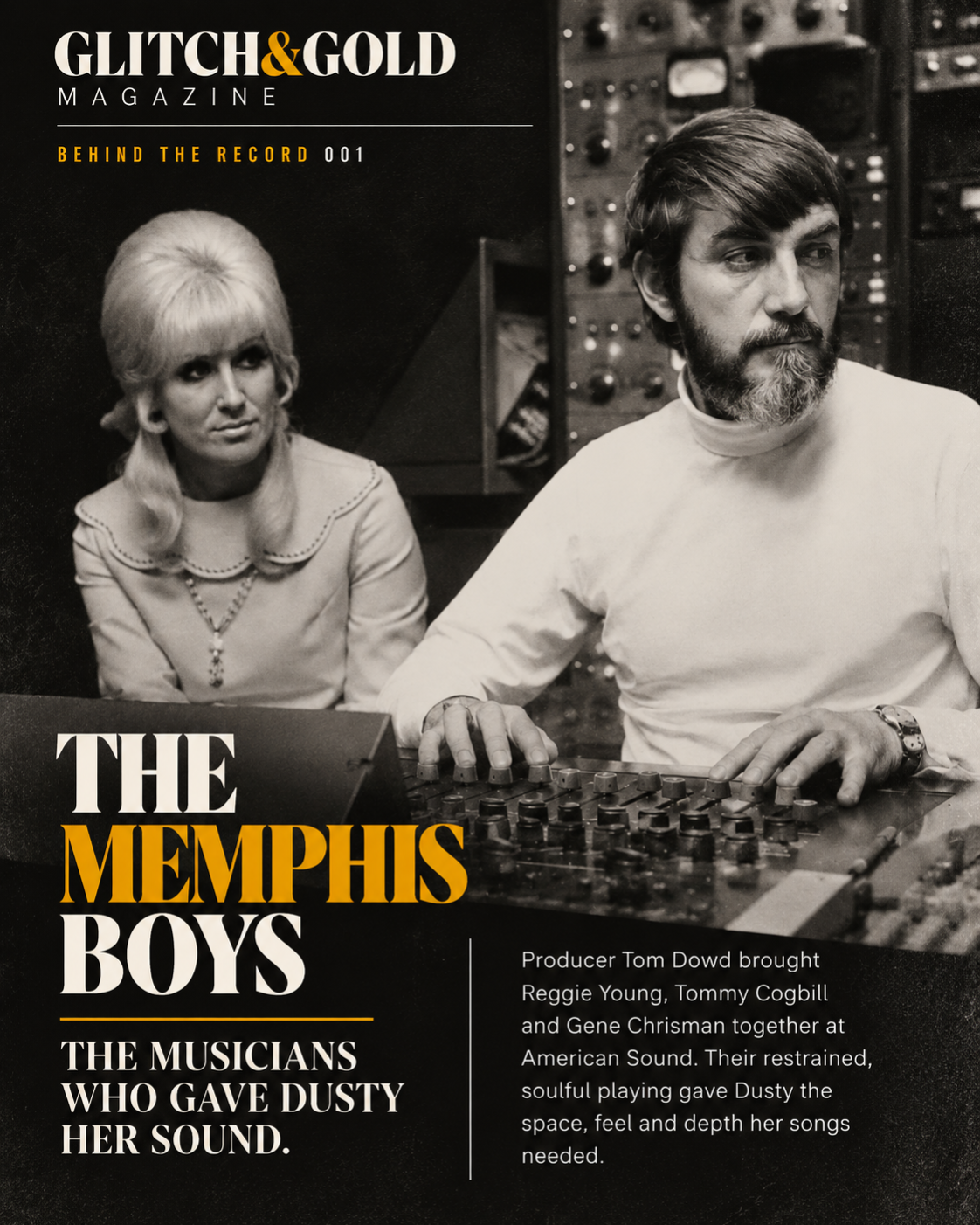
The studio's house musicians, known collectively as the Memphis Boys, had developed an astonishing ability to build records quickly.
They worked with artists from different musical backgrounds and seemed able to understand what a song required almost before anybody had finished explaining it.
This was a different recording culture from the one Springfield knew.
Wexler's approach relied on constructing the rhythm track from the ground up.
A few chords.
A bass figure.
A drum pattern.
A guitar answering something the keyboard had just suggested.
The arrangement emerged through the interaction of the musicians.
Wexler wanted the singer involved in that process.
Not necessarily delivering a finished performance, but giving the band a sense of where the words breathed, where a phrase might hesitate and where the song needed to turn.
Tom Dowd brought his considerable engineering and production experience to the sessions. Arif Mardin contributed the musical architecture, including arrangements that would help connect the rhythm-section performances with the record's more sophisticated pop elements.
Between them, the producers were trying to create something quite specific.
A record with the physical movement of Southern soul and the melodic richness of Springfield's best pop work.
Then came the difficulty nobody had anticipated.
DUSTY DOESN'T SING
Imagine the situation.
You have spent years admiring American soul singers.
Now you're standing in a studio associated with that music, surrounded by musicians who have helped make it.
You know exactly how good they are.
Possibly a little too well.
Springfield was famously exacting about her own performances, and the Memphis sessions presented her with an unfamiliar way of working.
She had previously been accustomed to singing against fuller arrangements, with more of the finished musical picture available around her.
Here, Wexler wanted her to participate while the rhythm tracks were still taking shape.
For a singer so attentive to detail, that could be deeply uncomfortable.
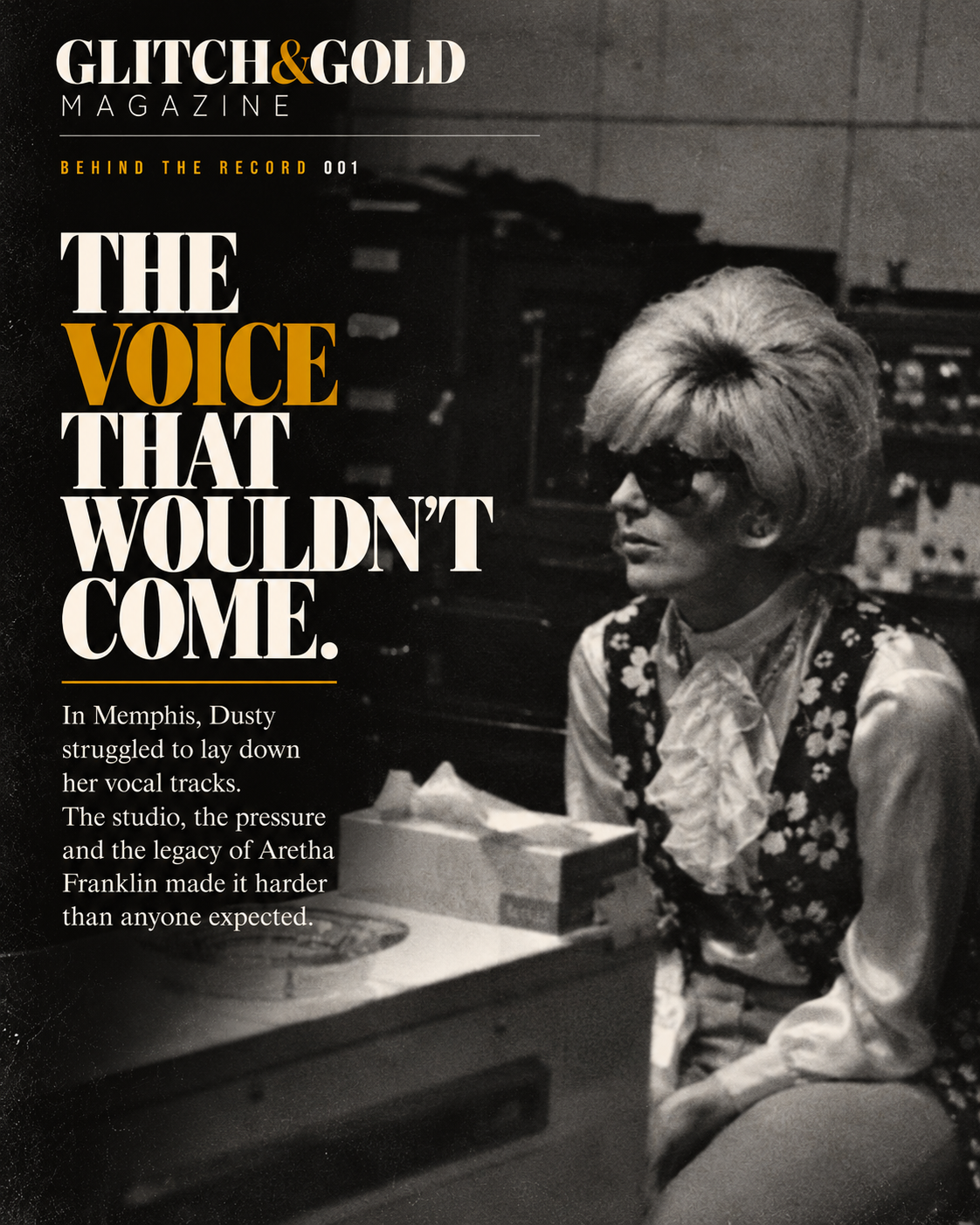
Wexler later recalled that she was reluctant to sing during the Memphis sessions.
He also connected her hesitation to the intimidation she felt about working in the environment of singers such as Aretha Franklin and Wilson Pickett.
His recollection is important, although it remains one producer's account of events.
It is tempting to turn the story into a grand psychological drama.
The great singer paralysed by self-doubt.
The genius unable to recognise her own gifts.
But that would be too neat.
What we know is that the recording process didn't work as Wexler had intended.
The Memphis musicians completed the instrumental foundations.
Springfield's lead vocals were subsequently finished in New York.
And the remarkable thing is how little of that difficulty you hear in the completed album.
The performances feel connected to the arrangements.
The pauses make sense.
The small rhythmic decisions sound natural.
You would never guess that the voice and the musicians had experienced such an awkward introduction.
Wexler himself later marvelled at how well the finished recordings fitted together.
There is an important distinction here.
Springfield did not fail to make the record she had travelled to Memphis to make.
She found a different way to finish it.
And the musicians had already given her something extraordinary to sing against.
THE MEN BEHIND THE GROOVE
Listen to Dusty in Memphis with the volume turned up a little.
Then try something.
For a moment, stop following Dusty's voice.
Listen to the bass.
Listen to the space between the snare drum and the guitar.
Listen to how often the musicians choose to play less.
That is where much of this album lives.
Reggie Young's guitar is a masterclass in economy. He can introduce a small phrase, disappear for a moment and return with an answer that makes the whole arrangement feel inevitable.
Tommy Cogbill's bass gives the songs movement without demanding attention.
Gene Chrisman's drumming is precise, relaxed and quietly insistent.
Bobby Emmons brings the keyboards into the conversation, while Bobby Wood and Mike Leech were also part of the wider American Sound musical operation.
These were musicians who understood that the most useful thing you could play was not necessarily the most impressive.
A singer like Springfield needed room.
Her performances depended on minute changes of emphasis, the way a word could arrive fractionally late or a phrase could soften just when another singer might have pushed harder.
The Memphis Boys provided that room.
They also gave the record its pulse.
The Sweet Inspirations added another essential layer. Their backing vocals could answer Springfield, support her or create a small burst of gospel-inflected energy around a line.
The orchestral arrangements, shaped by Mardin and conducted by Gene Orloff, brought a different kind of sophistication.
Strings and horns could have overwhelmed the rhythm section.
Instead, much of the record depends on the tension between those elements.
The polish of the arrangements.
The physical feel of the band.
And Springfield's voice finding a place somewhere between them.
ELEVEN SONGS, NO WASTED SPACE
Put the original album on.
Start at the beginning.
Just a Little Lovin’ is a particularly clever opening.
Written by Barry Mann and Cynthia Weil, it introduces the record with a gentle rhythmic confidence.
Nothing is in a hurry.
The arrangement moves with an easy, almost conversational pulse, and Springfield sings as though she is letting the listener in on something rather pleasant.
There is warmth in the performance, but also restraint.
She doesn't announce the arrival of a major artistic statement.
She simply begins singing.
And within a few lines, the album has established its atmosphere.
Then comes So Much Love, written by Goffin and King.
Here the emotional temperature rises.
The arrangement gives Springfield a foundation that can accommodate both tenderness and increasing intensity. She moves through the melody with a remarkable sense of control, allowing the feeling to gather rather than delivering everything at once.
Listen to how the accompaniment supports those changes.
The musicians know when to hold steady.
Springfield knows when to lean into the line.
It's a beautifully balanced performance.
And then, three tracks in, comes the song almost everybody knows.
THE PREACHER'S SON
Son of a Preacher Man has had a rather eventful life.
Written by John Hurley and Ronnie Wilkins, it was offered to Aretha Franklin before becoming Springfield's defining Atlantic single. Franklin initially passed on it, although she later recorded her own version.
An interesting piece of musical history, given how much Springfield admired her.
The record opens with a groove that seems to settle into place almost immediately.
Cogbill's bass moves with quiet assurance.
Chrisman's drums provide just enough forward motion.
Young's guitar contributes those wonderfully economical touches that give the arrangement its character.
And Springfield?
She sounds entirely at home.
There is a slyness to her delivery, a sense that the narrator remembers more than she is prepared to admit outright.
She doesn't oversing the story.
She enjoys it.
The lyric's mixture of innocence, secrecy and attraction gives her plenty to work with.
The Sweet Inspirations help make the performance feel communal, while the rhythm section keeps everything moving with the confidence of musicians who know precisely where the pocket is.
It became a major hit.
And decades later, Quentin Tarantino's Pulp Fiction introduced it to another generation.
But the song's lasting appeal doesn't depend on the film.
It works because every part of the recording understands the same idea.
A little suggestion can be far more effective than a grand declaration.
BREAKFAST, HEARTBREAK AND OTHER COMPLICATIONS
Further into the album, Breakfast in Bed offers a different sort of intimacy.
Written by Eddie Hinton and Donnie Fritts, it places the listener inside a domestic situation that feels both tender and emotionally complicated.
Springfield's performance is particularly effective because she resists turning the song into melodrama.
There is affection in her delivery.
There is also the unmistakable sense that somebody has been hurt.
The accompaniment remains measured, allowing the emotional situation to emerge through the words and the way she sings them.
A less disciplined performance might have pushed harder.
This one trusts the listener.
Randy Newman's I Don't Want to Hear It Anymore brings another perspective.
Newman had a gift for writing about uncomfortable human behaviour without offering much reassurance.
Springfield understands the character's wounded pride.
She lets the song's bitterness register without making it theatrical.
And then there is No Easy Way Down.
Another Goffin and King composition.
The song deals with the consequences of emotional risk, the moment when the possibility of happiness has already carried somebody somewhere dangerous.
Its writing is unusually perceptive.
The central image is simple, but the emotional implications are considerable.
Springfield gives it weight without treating every line as a catastrophe.
That is one of her greatest strengths throughout the album.
She knows how to inhabit a song.
She doesn't need to explain it.
Even The Windmills of Your Mind, with its elaborate circular imagery and Michel Legrand melody, benefits from that instinct.
It could easily become an exercise in vocal ornamentation.
Springfield instead keeps the listener close to the movement of the words.
Across these eleven recordings, the album moves between different writers and different emotional worlds.
Yet it feels remarkably coherent.
That coherence comes from the arrangements, the musicians and, above all, the singer's ability to make other people's songs sound as though they have been waiting for her.
THE HIT THAT DIDN'T SELL THE ALBUM
When Dusty in Memphis appeared in 1969, Son of a Preacher Man had already demonstrated that the collaboration could produce a hit.
The single reached the American top ten.
The album itself was another matter.
It peaked at number 99 on the US Billboard album chart.
For a project involving a major British singer, Atlantic Records and some of America's finest studio musicians, that was a modest result.
And it is important not to confuse sales with reception.
The record was admired by critics at the time.
Writing in Rolling Stone in 1969, Greil Marcus recognised the depth of the material and the unusual subtlety of Springfield's interpretation.
The problem wasn't that nobody could hear its qualities.
The wider record-buying public simply didn't respond in numbers comparable to the album's eventual reputation.
That reputation grew gradually.
Collectors kept returning to it.
Critics continued to discuss it.
Reissues made it available to new audiences.
And Son of a Preacher Man, already a familiar song, received another substantial burst of attention through Pulp Fiction in 1994.
By the time Dusty in Memphis was being routinely included in lists of the greatest albums ever recorded, its original chart position had become a historical curiosity.
The album was inducted into the Grammy Hall of Fame and later selected for the United States National Recording Registry.
Quite a career for a record that only reached number 99.
But perhaps its reputation makes more sense when you listen to the album as a whole.
It has none of the exhausting determination to impress that can make an ambitious recording feel dated.
The arrangements are sophisticated without becoming showy.
The band is exceptionally good without insisting on proving it.
And Springfield, whose anxiety had complicated the sessions, sounds completely engaged with the songs.
That combination has aged remarkably well.
THE VOICE THAT FOUND ITS PLACE
There is a photograph of Dusty Springfield on the original album cover.
The title tells us where we are supposed to imagine her.
Dusty in Memphis.
And in one sense, of course, she is there.
The musicians are there.
The rhythms, the arrangements and the musical decisions that give the album its character were shaped by the Memphis sessions.
But the voice we hear was largely completed in New York.
That detail might seem to undermine the romance of the title.
It actually makes the record more interesting.
Because Dusty in Memphis is a reminder that recording music is rarely as simple as placing talented people in a room and waiting for something wonderful to happen.
Sometimes the room is wrong for the singer.
Sometimes the process needs to change.
Sometimes a producer's preferred method doesn't suit the person standing in front of the microphone.
The achievement lies in recognising that the record matters more than the original plan.
Wexler, Dowd, Mardin and the Memphis musicians helped create the musical setting.
Springfield found her way into it.
And the result is an album in which nobody seems to be fighting for attention.
Listen again to Just a Little Lovin’.
Then So Much Love.
Then the remarkable ease of Son of a Preacher Man.
Notice how the band leaves space for the words.
How the backing voices arrive.
How Springfield can change the emotional meaning of a line with the smallest shift in emphasis.
It is all there.
The confidence.
The hesitation.
The discipline.
The extraordinary musicianship.
In September 1968, Dusty Springfield went to Memphis to make a record.
She couldn't finish singing it there.
And more than half a century later, we're still listening to what happened when everybody found another way.