
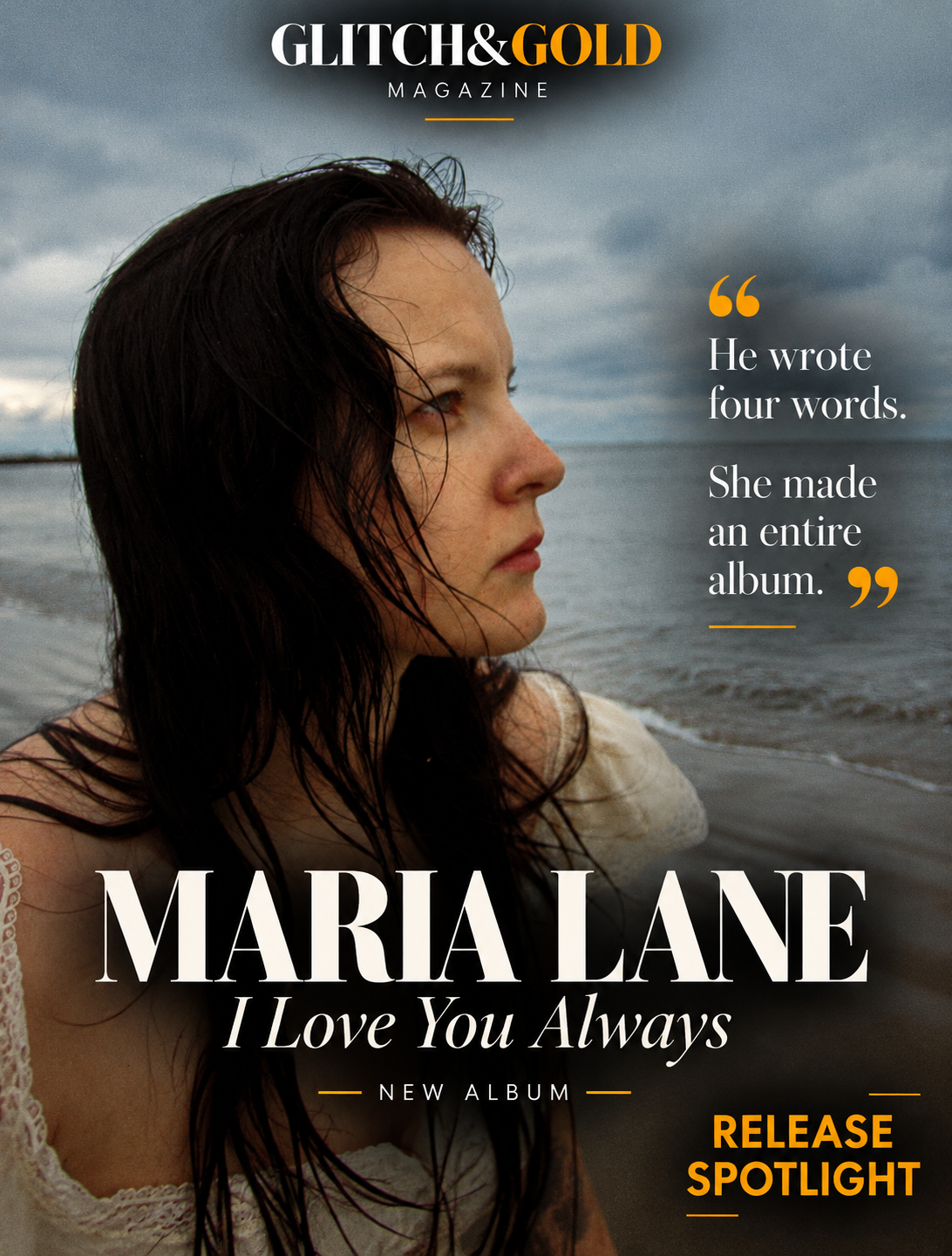
I LOVE YOU ALWAYS
Maria Lane | Release Spotlight
The last message Maria Lane received from him ended with four words.
“I love you always.”
She never answered.
Instead, she wrote a song.
Ten minutes of it.
And apparently ten minutes still wasn't enough, because those four words eventually found their way onto the cover of an entire album.
Fifteen songs.
Seventy-seven minutes.
Quite a long reply to a text message.
Although some things are difficult to explain in a text message.
Maria Lane calls her third album I Love You Always “a rom-com gone wrong.”
It grew out of a friendship that became love and eventually ended. Lane wrote all fifteen songs between July and October 2025, while the relationship was unfolding and in its aftermath.
What she has made from those months is a carefully constructed indie folk record, full of small details that become increasingly significant as the songs unfold.
And perhaps the most interesting thing about it is how much Lane has grown as a songwriter.
A DIFFERENT MARIA LANE
Lane has been moving away from traditional pop for some time.
On I Love You Always, that change feels substantial.
The record leans towards indie folk and alternative folk. The arrangements are darker, more inward, and considerably more patient than conventional pop songwriting usually allows.
There is less urgency to reach the next chorus.
Good.
Because Lane has quite a lot to say.
She wrote every track herself and co-produced the album with Justin Meyer. She considers it the closest her music has come to sounding the way she originally imagined it.
And across seventy-seven minutes, you begin to understand what she means.
The songs have room to develop. Ideas return. Images introduced early in the record acquire different meanings later.
Lane has deliberately avoided telling the story chronologically. She thinks of the album almost as a film, allowing information to emerge gradually.
It makes the sequencing important.
A song that initially sounds hopeful can feel quite different once you've heard what follows.
That is one of the album's strengths.
It rewards listening from beginning to end.
And for a fifteen-track record, that is no small achievement.
THE THINGS THAT STAY
Music has an irritating habit of remembering people.
You can go years without speaking to somebody and still find yourself thinking about them the moment a familiar song comes on.
Lane knows that feeling.
Music was central to the relationship behind this album. Radiohead was particularly important, and after it ended, artists they had shared kept appearing in her Spotify rotation.
Lane eventually allowed some of those influences into the album itself.
Partly out of anger, she admits.
She wanted those sounds to be recognised.
But the decision also helped shape the darker, more alternative direction of her own music.
And that is an interesting thing about I Love You Always.
Even the musical influences become part of the storytelling.
SMALL DETAILS, BIG SONGS
The opening track, airplanes in the sky, begins with a cancelled flight between California and New York.
An aeroplane becomes a symbol of two possibilities.
Someone arriving.
Someone remaining impossibly far away.
In saltwater tears, Lane is crying on the subway, trying to keep the people around her from noticing.
The relationship hasn't ended yet. She is already afraid of losing it.
Later, she imagines herself planted in somebody's garden, watered and cared for.
Such an ordinary image.
And such a recognisable wish.
To feel safe somewhere.
This is where Lane's writing is particularly effective.
She finds emotional weight in things people encounter every day.
A plane. A subway. A garden. A birthday.
The details are hers, but the feelings don't require an explanation.
Then there is the waves crashed safely.
One of the tracks we kept returning to during our listening, and possibly our personal standout from the album.
Interestingly, Lane hasn't supplied an elaborate backstory for it.
We didn't need one.
The atmosphere, the patience of the song and the writing itself were enough to hold our attention.
It is an important distinction.
An album built around such a personal experience still needs songs that can live independently of that experience.
This one does.
The earlier single twist the knife introduced this chapter of Lane's music before the album arrived.
Within the full record, it finds a different place.
That is the benefit of hearing these songs together. They begin to inform one another, and the album becomes more absorbing as it progresses.
TEN MINUTES
And then comes the title track.
A little over ten minutes long.
Lane wrote it roughly a week after the final phone call, following that last message.
“I love you always.”
She never replied.
She sat down and wrote.
And kept writing.
There is something rather refreshing about that.
Pop music has spent decades teaching us that a song should know when to leave.
Lane appears to have decided that this particular song could stay a little longer.
The length feels entirely consistent with the rest of the album.
Thoughts are revisited. Questions remain unanswered. The writing moves at its own pace.
And underneath it sits something many people will recognise.
Someone can love you and still leave.
It is a difficult contradiction to make sense of.
Lane gives herself ten minutes to try.
The song became the centre of the record, and those four words eventually became its title.
ONE MORE SONG
Jeff Buckley's Last Goodbye was playing on the day Lane and her partner first met in person.
After their final phone call, Lane wrote her own last goodbye.
She had a performance scheduled that evening.
So she wrote the song.
Then went on stage and performed it.
That very night.
Some of the lyrics came from a poem he had written for her during the relationship.
Lane also considers the track an homage to Buckley.
It is another example of how music and memory run through this album, finding their way into both the writing and the sound.
WHAT REMAINS
By the time raining in california closes the record, the geography has come full circle.
We began with a cancelled flight between California and New York.
Fifteen songs later, California is still there.
Lane has made something that preserves the relationship without pretending its ending didn't hurt.
But the album works because those feelings don't belong exclusively to her.
Everybody brings their own people, places, songs and memories into music.
And I Love You Always leaves plenty of room for them.
It is a substantial step forward for Lane as a songwriter and co-producer. The folkier direction suits her, the longer arrangements give her writing space, and the album's careful construction rewards the time it asks of us.
There is tenderness here, even when the songs become darker.
Perhaps especially then.
And somewhere in the middle of those fifteen songs sits a ten-minute answer to four words she never replied to.
“I love you always.”
He wrote them.
She made the album.